Rhapta and Mafia Island: Tanzania’s Submerged Ancient Trade Mystery
Like Rhapta, Africa’s history is not missing. It is submerged—patiently waiting to be remembered.
For centuries, Rhapta has occupied a rare place in African history: known through ancient texts, argued over by scholars, and imagined through descriptions rather than ruins that could be clearly placed on a map.
Classical sources described it as a powerful trading city on the southeastern coast of Africa, connected to Arabia, India, the Persian Gulf and the Mediterranean through the Indian Ocean. It was said to be a place of commerce, movement and maritime skill; a port where ivory, tortoiseshell, metal goods and other valuable commodities passed through the hands of traders who understood the rhythm of the monsoon winds.
Then, sometime around the 4th century AD, Rhapta faded from the written record.
There is no clear account of its destruction. No dramatic conquest. No final battle. No single moment that explains its disappearance. It simply slipped out of recorded history, leaving behind one of the most compelling questions on the East African coast: where was Rhapta?
A Mystery of Mafia Island
In the early 21st century, that question returned with new force off the coast of Mafia Island, Tanzania.
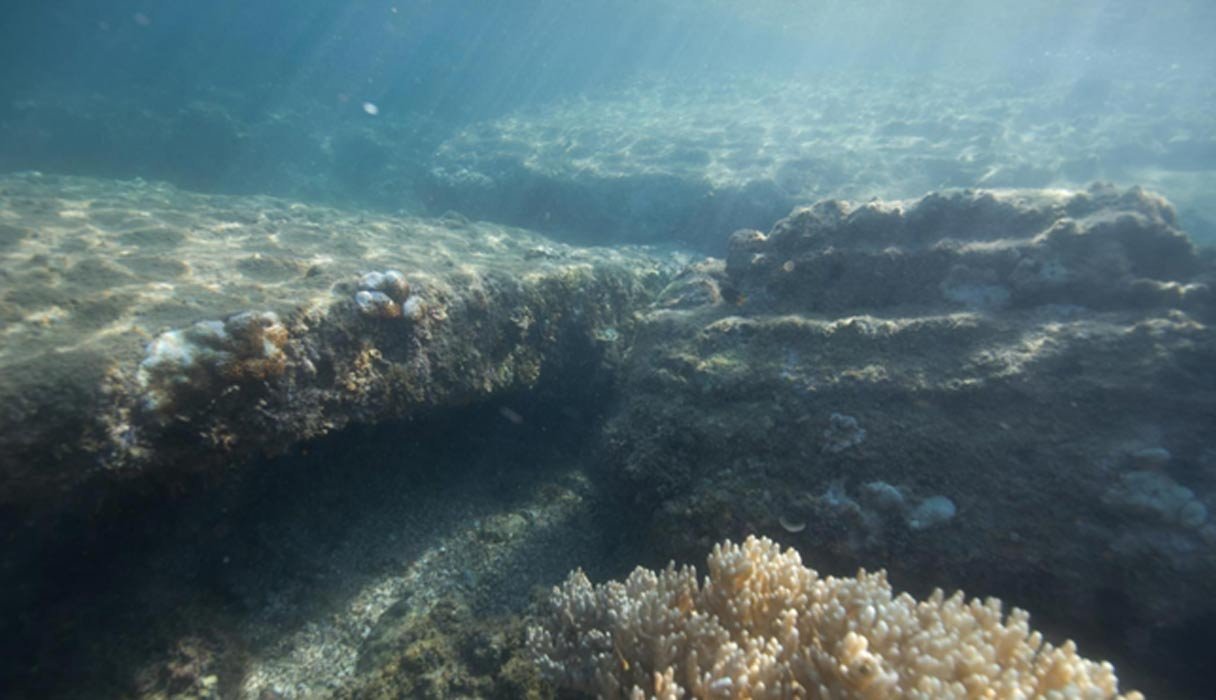
During a helicopter flight, scuba diver Alan Sutton noticed unusual geometric shapes beneath the water. They did not appear to follow the natural patterns of coral or reef. From above, the formations looked arranged, almost intentional.
What began as an observation became a long investigation involving repeated dives, mapping and photographic documentation. Beneath the surface, Sutton identified formations that appeared to include square and rectangular stone blocks, aligned foundations and structures that some researchers believe may be consistent with harbour infrastructure.
The scale of what was observed raised a larger possibility. These were not easily dismissed as the traces of a small settlement. They suggested something more substantial — perhaps the remains of an ancient coastal city.
Ancient Texts, Modern Clues
The discovery attracted the interest of archaeologists, including scholars from the University of Dar es Salaam. Among them was Professor Felix Chami, one of the region’s leading voices in Swahili and Indian Ocean archaeology.
The case for Rhapta rests on several clues: geography, ancient descriptions, construction remains, ceramics and the broader history of Indian Ocean trade. The most important written source is the Periplus of the Erythraean Sea, a 1st-century maritime guide that described trade routes along the Red Sea and Indian Ocean.
In that text, Rhapta is presented as a major commercial centre and the southernmost port of Azania, a term used by ancient writers for parts of the East African coast. Roman geographers also referred to an island called Mafiaco, a name that some scholars see as strikingly close to Mafia.
None of this closes the debate entirely. Archaeology is careful by nature, and absolute confirmation requires further research. But the possibility that the ruins near Mafia Island may be linked to Rhapta has given Tanzania one of the most fascinating historical narratives on the African coast.
Africa at the Centre of the Ancient World
If the Mafia Island ruins are confirmed as Rhapta, the significance would be profound.
Rhapta would stand as one of the earliest known urban and maritime centres in sub-Saharan Africa, deeply connected to global trade nearly two thousand years ago. It would show that the East African coast was not a distant edge of the ancient world, but part of a living commercial system that connected Africa’s interior to Arabia, India and the Mediterranean.
This matters because it challenges an old misconception: that ancient Africa was isolated from global exchange.
The evidence points in another direction. The Swahili Coast was maritime, skilled, outward-looking and commercially sophisticated. The Indian Ocean was not a barrier. It was a route. It carried goods, languages, technologies, beliefs and people across great distances.
Rhapta reminds us that Africa’s ancient history was not waiting to be connected to the world. It was already connected.
Why Did Rhapta Disappear?
The disappearance of Rhapta is part of its power as a story.
Some cities fall violently. Others are abandoned after war, fire or conquest. Rhapta appears to have disappeared more quietly. Scholars have suggested several possible reasons: shifting trade routes, changes in political influence across the Indian Ocean, coastal transformation, sedimentation, sea-level change, or the gradual movement of commercial power to other ports.
There may never have been one single cause. A city built around trade can decline when the routes that sustain it move elsewhere. A coastal city can be reshaped by water, sand and time. A port that once stood at the centre of exchange can become silent when ships begin to favour another harbour.
In that sense, Rhapta may not have vanished suddenly. It may have been slowly overtaken by history, landscape and the sea.
The Sea as Memory
Rhapta is not the only ancient city whose story has been held beneath water.
In Egypt, the rediscovery of Heracleion showed how a city once thought almost mythical could remain preserved under the sea for centuries. Streets, temples, statues, ships and inscriptions were found beneath layers of sediment, changing how scholars understood the ancient Mediterranean world.
Rhapta belongs to that same kind of human fascination. It speaks to the way the sea connects civilizations, but also protects their secrets. Along Tanzania's coast, the ocean is not just scenery. It is an archive.
Mafia Island Beyond the Beach
Mafia Island is often described through its natural beauty: clear waters, coral reefs, marine life, diving, whale sharks, mangroves and quiet beaches. All of that is true. It is one of Tanzania’s most atmospheric island destinations.
But Mafia is more than a beach escape.
It sits inside a much older story of movement across the Indian Ocean. Its waters, villages, ruins and maritime traditions carry traces of a coastline that has traded, travelled and adapted for centuries. For travellers who look closely, Mafia Island offers something deeper than tropical calm. It offers a sense of historical presence.
This is what makes the destination exceptional. You do not come here only to swim, dive or rest. You come to stand at the edge of a coastline that may have helped shape one of Africa’s earliest global connections.
The Zamia Africa Perspective
At Zamia Africa, we believe the best journeys are not built around spectacle. They are built around meaning.
Mafia Island is beautiful, but its beauty is only the beginning. The deeper value lies in what the island represents: a quieter, older Tanzania shaped by ocean routes, ancient trade, coastal communities and stories that have not yet been fully told.
To travel here is not simply to visit an island. It is to enter a landscape where nature and history meet. The reef, the dhow, the village, the ruins and the sea all belong to one larger story.
Luxury, at its highest level, is not excess. It is attention. It is the ability to slow down enough to understand where you are.
Mafia Island offers that kind of travel. It invites you to look beyond the surface and listen to the coast.
Because if Rhapta teaches us anything, it is that Africa’s history is not missing.
Some of it is written in stone.
Some of it is carried by memory.
And some of it still rests beneath the Indian Ocean, waiting to be understood.